 086bfab8b3
 [](https://github.com/yaooqinn/kyuubi/pull/291) [❨?❩](https://pullrequestbadge.com/?utm_medium=github&utm_source=yaooqinn&utm_campaign=badge_info)<!-- PR-BADGE: PLEASE DO NOT REMOVE THIS COMMENT --> <!-- Thanks for sending a pull request! Here are some tips for you: 1. If this is your first time, please read our contributor guidelines: https://kyuubi.readthedocs.io/en/latest/community/contributions.html --> ### Please add issue ID here? <!-- replace ${issue ID} with the actual issue id --> fixes #291 ### Why are the changes needed? <!-- Please clarify why the changes are needed. For instance, 1. If you add a feature, you can talk about the user case of it. 2. If you fix a bug, you can clarify why it is a bug. --> add documentation for dbeaver database tool ### Test Plan: - Add some test cases that check the changes thoroughly including negative and positive cases if possible - Add screenshots for manual tests if appropriate 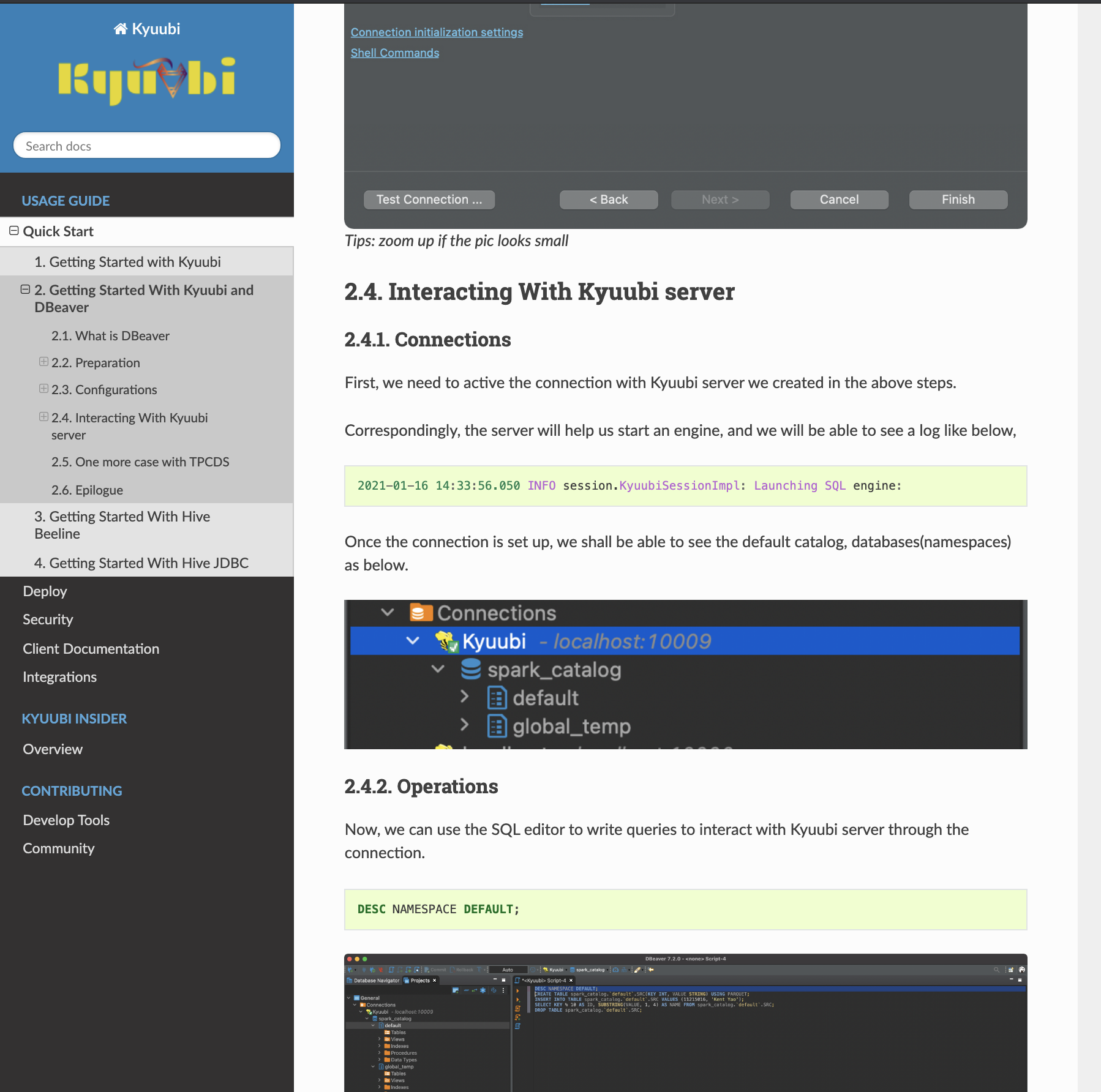 - [Run test](https://kyuubi.readthedocs.io/en/latest/tools/testing.html#running-tests) locally before make a pull request * dbeaver * dbeaver * nit

245 lines
11 KiB
Markdown
245 lines
11 KiB
Markdown
<script async defer src="https://buttons.github.io/buttons.js"></script>
|
|
<div align=center>
|
|
|
|

|
|
|
|
</div>
|
|
|
|
# Getting Started with Kyuubi
|
|
|
|
|
|
## Getting Kyuubi
|
|
|
|
Currently, Kyuubi maintains all releases on GitHub directly. You can get the most recent stable release of Kyuubi here:
|
|
|
|
<a class="github-button" href="https://github.com/yaooqinn/kyuubi/releases" data-color-scheme="no-preference: light; light: dark; dark: light;" data-icon="octicon-download" data-size="large" aria-label="Download yaooqinn/kyuubi on GitHub">Download</a>
|
|
|
|
## Requirements
|
|
|
|
These are essential components required for Kyuubi to startup. For quick start deployment, the only thing you need is `JAVA_HOME` being correctly set. The Kyuubi release package you downloaded or built contains the rest prerequisites inside already.
|
|
|
|
Components| Role | Optional | Version | Remarks
|
|
--- | --- | --- | --- | ---
|
|
Java | Java<br>Runtime<br>Environment | Required | 1.8 | Kyuubi is pre-built w/ Java 1.8
|
|
Spark | Distribute<br>SQL<br>Engine | Optional | 3.0.x | By default Kyuubi is pre-built w/<br> a Apache Spark release inside at<br> `$KYUUBI_HOME/externals`
|
|
HDFS | Distributed<br>File<br>System | Optional | referenced<br>by<br>Spark | Hadoop Distributed File System is a <br>part of Hadoop framework, used to<br> store and process the datasets.<br> You can interact w/ any<br> Spark-compatible versions of HDFS.
|
|
Hive | Metastore | Optional | referenced<br>by<br>Spark | Hive Metastore for Spark SQL to connect
|
|
Zookeeper | Service<br>Discovery | Optional | Any<br>zookeeper<br>ensemble<br>compatible<br>with<br>curator(2.7.1) | By default, Kyuubi provides a<br> embeded Zookeeper server inside for<br> non-production use.
|
|
|
|
Additionally, if you want to work with other Spark compatible systems or plugins, you only need to take care of them as using them w/ regular Spark applications. For example, you can run Spark SQL engines created by the Kyuubi on any kind of cluster manager, including YARN, Kubernetes, Mesos, e.t.c... Or, you can manipulate data from different data sources w/ the Spark Datasource API, e.g. Delta Lake, Apache Hudi, Apache Iceberg, Apache Kudu and e.t.c...
|
|
|
|
## Installation
|
|
|
|
To install Kyuubi, you need to unpack the tarball. For example,
|
|
|
|
```bash
|
|
tar zxf kyuubi-1.0.2-bin-spark-3.0.1.tar.gz
|
|
```
|
|
|
|
This will result in the creation of a subdirectory named `kyuubi-1.0.0-SNAPSHOT-bin-spark-3.0.1` shown below, where the `1.0.0-SNAPSHOT` is the Kyuubi version and `3.0.1` is the pre-built Spark version.
|
|
|
|
```bash
|
|
kyuubi-1.0.2-bin-spark-3.0.1
|
|
├── LICENSE
|
|
├── RELEASE
|
|
├── bin
|
|
│ └── kyuubi
|
|
├── conf
|
|
│ ├── kyuubi-defaults.conf
|
|
│ ├── kyuubi-env.sh
|
|
│ └── log4j.properties
|
|
├── externals
|
|
│ ├── engines
|
|
│ └── spark-3.0.1-bin-hadoop2.7
|
|
├── jars
|
|
├── logs
|
|
├── pid
|
|
└── work
|
|
```
|
|
|
|
From top to bottom are:
|
|
|
|
- LICENSE: the [APACHE LICENSE, VERSION 2.0](https://www.apache.org/licenses/LICENSE-2.0) we claim to obey.
|
|
- RELEASE: the build information of this package
|
|
- bin: the entry of the Kyuubi server w/ `kyuubi` as the startup script.
|
|
- conf: all the defaults used by Kyuubi Server itself or creating session with Spark applications.
|
|
- externals
|
|
- engines: contains all kinds of SQL engines that we support, e.g. Apache Spark, Apache Flink(coming soon).
|
|
- spark-3.0.1-bin-hadoop2.7: a pre-downloaded official Spark release, used as default.
|
|
- jars: packages needed by the Kyuubi server.
|
|
- logs: Where the logs of Kyuubi server locates.
|
|
- pid: stores the pid file of Kyuubi server instance.
|
|
- work: the root of the working directories of all the forked sub-processes a.k.a. SQL engines.
|
|
|
|
|
|
## Running Kyuubi
|
|
|
|
As mentioned above, for a quick start deployment, the only you need to be sure is that your java runtime environment is correct.
|
|
|
|
### Setup JAVA
|
|
|
|
Your can either set it system-widely, e.g. in the `.bashrc` file.
|
|
|
|
```bash
|
|
java -version
|
|
java version "1.8.0_251"
|
|
Java(TM) SE Runtime Environment (build 1.8.0_251-b08)
|
|
Java HotSpot(TM) 64-Bit Server VM (build 25.251-b08, mixed mode)
|
|
```
|
|
|
|
Or, `export JAVA_HOME=/path/to/java` in the local os session.
|
|
|
|
```bash
|
|
export JAVA_HOME=/Library/Java/JavaVirtualMachines/jdk-11.0.5.jdk/Contents/Home
|
|
java -version
|
|
java version "11.0.5" 2019-10-15 LTS
|
|
Java(TM) SE Runtime Environment 18.9 (build 11.0.5+10-LTS)
|
|
Java HotSpot(TM) 64-Bit Server VM 18.9 (build 11.0.5+10-LTS, mixed mode)
|
|
|
|
```
|
|
|
|
But, the recommended place to set `JAVA_HOME` is `$KYUUBI_HOME/conf/kyuubi-env.sh`, as the ways above are too flaky.
|
|
The `JAVA_HOME` in `$KYUUBI_HOME/conf/kyuubi-env.sh` will take precedence of others.
|
|
|
|
### Starting Kyuubi
|
|
|
|
|
|
```bash
|
|
bin/kyuubi start
|
|
```
|
|
|
|
During the server starts, it will print all essential environment variables on the screen, you may check whether they are expected.
|
|
|
|
```logtalk
|
|
Starting Kyuubi Server from /Users/kentyao/kyuubi/kyuubi-1.0.0-SNAPSHOT-bin-spark-3.0.1
|
|
Using kyuubi.sh environment file /Users/kentyao/kyuubi/kyuubi-1.0.0-SNAPSHOT-bin-spark-3.0.1/conf/kyuubi-env.sh to initialize...
|
|
JAVA_HOME: /Library/Java/JavaVirtualMachines/jdk1.8.0_251.jdk/Contents/Home
|
|
KYUUBI_HOME: /Users/kentyao/kyuubi/kyuubi-1.0.0-SNAPSHOT-bin-spark-3.0.1
|
|
KYUUBI_CONF_DIR: /Users/kentyao/kyuubi/kyuubi-1.0.0-SNAPSHOT-bin-spark-3.0.1/conf
|
|
KYUUBI_LOG_DIR: /Users/kentyao/kyuubi/kyuubi-1.0.0-SNAPSHOT-bin-spark-3.0.1/logs
|
|
KYUUBI_PID_DIR: /Users/kentyao/kyuubi/kyuubi-1.0.0-SNAPSHOT-bin-spark-3.0.1/pid
|
|
KYUUBI_WORK_DIR_ROOT: /Users/kentyao/kyuubi/kyuubi-1.0.0-SNAPSHOT-bin-spark-3.0.1/work
|
|
SPARK_HOME: /Users/kentyao/kyuubi/kyuubi-1.0.0-SNAPSHOT-bin-spark-3.0.1/externals/spark-3.0.1-bin-hadoop2.7
|
|
SPARK_CONF_DIR:
|
|
HADOOP_CONF_DIR:
|
|
Starting org.apache.kyuubi.server.KyuubiServer, logging to /Users/kentyao/kyuubi/kyuubi-1.0.0-SNAPSHOT-bin-spark-3.0.1/logs/kyuubi-kentyao-org.apache.kyuubi.server.KyuubiServer-hulk.local.out
|
|
Welcome to
|
|
__ __ __
|
|
/\ \/\ \ /\ \ __
|
|
\ \ \/'/' __ __ __ __ __ __\ \ \____/\_\
|
|
\ \ , < /\ \/\ \/\ \/\ \/\ \/\ \\ \ '__`\/\ \
|
|
\ \ \\`\\ \ \_\ \ \ \_\ \ \ \_\ \\ \ \L\ \ \ \
|
|
\ \_\ \_\/`____ \ \____/\ \____/ \ \_,__/\ \_\
|
|
\/_/\/_/`/___/> \/___/ \/___/ \/___/ \/_/
|
|
/\___/
|
|
\/__/
|
|
|
|
```
|
|
|
|
If all goes well, this will result in the creation of the Kyuubi server instance with a `PID` stored in `$KYUUBI_HOME/pid/kyuubi-<username>-org.apache.kyuubi.server.KyuubiServer.pid`
|
|
|
|
Then, you can get the JDBC connection url at the end of log file, e.g.
|
|
|
|
```
|
|
FrontendService: Starting and exposing JDBC connection at: jdbc:hive2://localhost:10009/
|
|
```
|
|
|
|
If something goes wrong, you shall be able to find some clues in the log file too.
|
|
|
|
## Using Hive Beeline
|
|
|
|
Kyuubi server is compatible with Apache Hive beeline,
|
|
and a builtin beeline tool can be found within the pre-built Spark package in the `$KYUUBI_HOME/externals` directory, e.g. `$KYUUBI_HOME/externals/spark-3.0.1-bin-hadoop2.7/bin/beeline`
|
|
|
|
### Opening a Connection
|
|
|
|
The command below will tell Kyuubi server to create a session with itself.
|
|
|
|
```logtalk
|
|
bin/beeline -u 'jdbc:hive2://localhost:10009/'
|
|
Connecting to jdbc:hive2://localhost:10009/
|
|
Connected to: Spark SQL (version 1.0.0-SNAPSHOT)
|
|
Driver: Hive JDBC (version 2.3.7)
|
|
Transaction isolation: TRANSACTION_REPEATABLE_READ
|
|
Beeline version 2.3.7 by Apache Hive
|
|
0: jdbc:hive2://localhost:10009/>
|
|
```
|
|
|
|
In this case, the session will create for the user named 'anonymous'.
|
|
|
|
Kyuubi will create a Spark SQL engine application using `kyuubi-spark-sql-engine-<version>.jar` if there is no existing one.
|
|
It will cost a while for the application to be ready before the session is fully established.
|
|
Otherwise, an existing application will be resued and the time cost here is negligible.
|
|
|
|
Similarly, you can create a session for another user(or principal, subject, and maybe something else you defined), e.g. named `kentyao`,
|
|
|
|
```bash
|
|
bin/beeline -u 'jdbc:hive2://localhost:10009/' -n kentyao
|
|
```
|
|
|
|
The formerly created Spark application for user 'anonymous' will not be reused in this case, while a brand new application will be submitted for user 'kentyao' instead.
|
|
|
|
Then, you can see 3 processes running in your local environment, including one `KyuubiServer` instance and 2 `SparkSubmit` instance as the SQL engines.
|
|
|
|
```
|
|
75730 Jps
|
|
70843 KyuubiServer
|
|
72566 SparkSubmit
|
|
75356 SparkSubmit
|
|
```
|
|
### Execute Statements
|
|
|
|
If the beeline session is successfully connected, then you can run any query supported by Spark SQL now. For example,
|
|
|
|
```logtalk
|
|
0: jdbc:hive2://localhost:10009/> select timestamp '2018-11-17';
|
|
2020-11-02 20:51:49.019 INFO operation.ExecuteStatement:
|
|
Spark application name: kyuubi_kentyao_spark_20:44:57.240
|
|
application ID: local-1604321098626
|
|
application web UI: http://10.242.189.214:64922
|
|
master: local[*]
|
|
deploy mode: client
|
|
version: 3.0.1
|
|
Start time: 2020-11-02T12:44:57.398Z
|
|
User: kentyao
|
|
2020-11-02 20:51:49.501 INFO codegen.CodeGenerator: Code generated in 13.673142 ms
|
|
2020-11-02 20:51:49.625 INFO spark.SparkContext: Starting job: collect at ExecuteStatement.scala:49
|
|
2020-11-02 20:51:50.129 INFO scheduler.DAGScheduler: Job 0 finished: collect at ExecuteStatement.scala:49, took 0.503838 s
|
|
2020-11-02 20:51:50.151 INFO codegen.CodeGenerator: Code generated in 9.685752 ms
|
|
2020-11-02 20:51:50.228 INFO operation.ExecuteStatement: Processing kentyao's query[d80a2664-342d-4f38-baaa-82e88e68a43b]: RUNNING_STATE -> FINISHED_STATE, statement: select timestamp '2018-11-17', time taken: 1.211 seconds
|
|
+----------------------------------+
|
|
| TIMESTAMP '2018-11-17 00:00:00' |
|
|
+----------------------------------+
|
|
| 2018-11-17 00:00:00.0 |
|
|
+----------------------------------+
|
|
1 row selected (1.466 seconds)
|
|
```
|
|
|
|
As shown in the above case, you can retrieve all the operation logs, the result schema, and the result to your client side in the beeline console.
|
|
|
|
Additionally, some usefully information about the background Spark SQL application that associated with this connection is also printed in the operation log.
|
|
For example, you can get the Spark web UI from the log for debugging or tuning.
|
|
|
|

|
|
|
|
### Closing a Connection
|
|
|
|
Close the session between beeline and Kyuubi server by executing `!quit`, for example,
|
|
|
|
```bash
|
|
0: jdbc:hive2://localhost:10009/> !quit
|
|
Closing: 0: jdbc:hive2://localhost:10009/
|
|
```
|
|
|
|
## Stopping Kyuubi
|
|
|
|
Stop Kyuubi by running the following in the `$KYUUBI_HOME` directory:
|
|
|
|
```bash
|
|
bin/kyuubi.sh stop
|
|
```
|
|
|
|
The `KyuubiServer` instance will be stopped immediately while the SQL engines application will still be alive for a while.
|
|
|
|
If you start kyuubi again before the SQL engine application terminate itself, they will reconnect to the newly create `KyuubiServer` instance.
|